
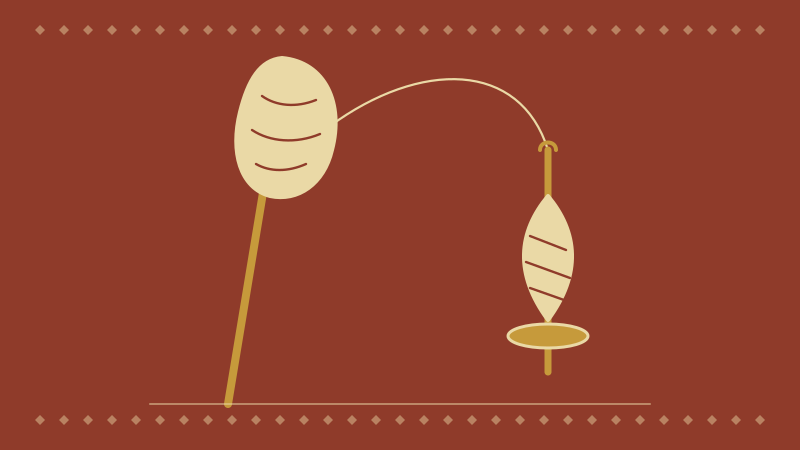
If you could walk into a Viking Age house on an ordinary afternoon, the first thing you would notice about the women is that their hands were never still. They would be spinning. They spun while they talked, while they watched the children, while they walked to the shieling. I want to argue that you cannot understand the religion of these people without understanding that.
The arithmetic of cloth
The spindle whorl, the small weight that keeps a spindle turning, is among the most common finds on any early medieval settlement. There is a reason. Everything made of cloth began as fiber twisted between a woman's fingers, a few handspans at a time.
I spin with a drop spindle of the old type. Working steadily, I can make perhaps forty or fifty meters of fine thread in an hour. A single tunic needs several kilometers. A household needed clothes, blankets, sacks, bandages, and tents. A ship needed a sail, and experiments have shown that the sail of a large ship could consume more working time than the ship itself. In Iceland, lengths of homespun were legal tender.
After spinning came weaving, on the tall upright loom that leaned against the wall of the house. Its warp threads were held taut by rows of clay or stone weights, which archaeologists find lying in lines where a loom once stood and burned. A weaver worked standing, walking to and fro, beating the weft upward with a sword-shaped batten.
This was the constant background of women's lives for thousands of years. It was skilled, it was essential, and it was theirs.
Fate as thread
People think with what they know. A society of spinners, asked to imagine how a life is shaped, imagined thread.
In one of the heroic poems of the Edda, the Norns come by night to the birth of a prince. They twist the strands of his fate with strength, and stretch the golden threads across the sky, fastening them east and west. It is an image that only a spinner could have made: a life as something drawn out, twisted firm, and tied off.
The same thought has a terrible form. In a poem preserved in Njal's Saga, a man looks into a women's weaving room on the morning of a great battle and sees twelve Valkyries at a loom. The warp is made of men's entrails. The weights are severed heads. The batten is a sword. As they weave they chant the outcome of the fighting. When they finish they tear the cloth apart and ride away, each with her piece.
I have stood at a warp-weighted loom, and I can tell you that the poet knew exactly how one works.
Frigg's distaff
The goddess Frigg is said in the poems to know all fates. In the folk tradition of Sweden, the three bright stars that others call Orion's belt were known as Frigg's distaff. Somebody, long ago, looked up at the winter sky and saw the queen of the gods at her spinning. It is a small piece of evidence, but I find it difficult to resist.
Cloth as memory
Weaving was also how women recorded things. In the legends of the Volsungs, the heroine Gudrun, in exile, embroiders a great hanging with the ships and battles of heroes. Brynhild weaves the deeds of Sigurd in gold. The tapestry buried with the Oseberg women shows a long procession of wagons, horses, and figures, a narrative in wool whose meaning we can no longer read.
We are used to thinking of the poet in the hall as the keeper of memory. There was another keeper, in the women's room, and she kept it in thread.
Thread and magic
From here it is a short step to magic, and the sources take it. A medieval handbook for confessors asks women whether they have worked spells into their weaving as they began a web. An earl of Orkney is said in the sagas to have carried a raven banner woven by his mother, who was skilled in magic: it brought victory to the man it was carried before, and death to the man who carried it.
Some scholars have gone further. The staff of the seeress, as it survives in graves, looks a good deal like a distaff, and the word seidr itself may be related to old words for a cord or a snare. On this view the seeress spins something unseen: she draws out a thread, and with it draws things to her. It cannot be proved. But it would make sense of a great deal.
The spindle side
In his will, King Alfred of Wessex distinguished the two lines of his family as the spear side and the spindle side. In English a mother's kin are still, now and then, called the distaff side.
For a long time that phrase was heard as a diminishment: the men had spears and the women merely spun. I hope I have said enough to suggest how badly that misreads the evidence. The spindle clothed the people, rigged the ships, served as money, recorded history, and supplied the central image for fate itself.
That is why our journal is called The Distaff, and why the emblem of Heathen Women United is a spindle. We are not ashamed of the spindle side. We think it held the world together.