
The discovery
In 1903 a farmer in Vestfold, on the western shore of the Oslo fjord, dug into a large mound on his land and struck carved oak. The excavation the following summer uncovered the best-preserved Viking ship ever found.
The ship had been dragged ashore, set in a trench, and buried under a mound of turf and blue clay that sealed it from the air for more than a thousand years. Tree-ring dating shows that it was built around 820 and that the timbers of the burial chamber were felled in the summer of 834.
The ship
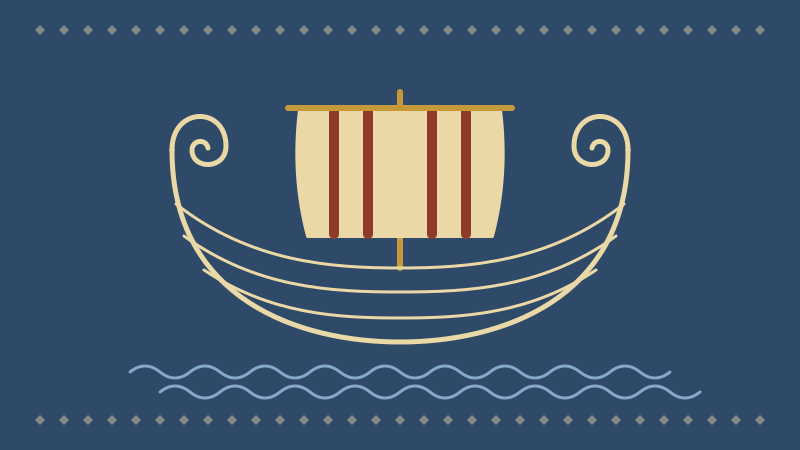
The Oseberg ship is about twenty-one and a half meters long and five wide, built of oak, with places for thirty oars and a mast for a single square sail. Its prow and stern rise in tall spirals, and both are carved with bands of interlaced animals of extraordinary quality. It is a vessel made to be looked at: a ship of state, suited to sheltered waters and to occasions of ceremony.
The two women
In a timber chamber behind the mast lay the remains of two women. One was very old for her time, perhaps seventy or eighty, and had suffered from serious illness in her last years. The other was around fifty. They had been laid on beds made up with fine linen and down.
We do not know their names. We do not know which of them the burial was made for, or whether it honored both. An old proposal identified the elder as a queen named in the sagas, but nothing confirms it. It has been suggested that one accompanied the other in death; nothing confirms that either. What is certain is that the community that buried them spent a fortune to do it.
What was buried with them
The mound was broken into in ancient times and anything of gold or silver was taken. What the robbers left is still the richest collection of Viking Age objects in existence.
- A carved wagon, the only complete one to survive from the period, its sides covered with scenes that may be mythological.
- Four sledges, three of them ornately carved, and five animal-head posts whose purpose is unknown.
- Beds, a chair, chests, lamps, and a full set of kitchen equipment, including food for a journey.
- Textile tools: looms, a tablet-weaving frame with the tablets still threaded, spindles, and combs.
- Textiles: fine wool, imported silk, and the fragments of a narrow woven tapestry showing a procession of wagons, horses, and walking figures, many of them women.
- Animals: about fifteen horses, along with oxen and dogs, killed at the graveside.
Queen, priestess, or both
For a long time the Oseberg women were assumed to be a queen and her servant. More recent work has drawn attention to how much in the grave points toward religion.
The wagon recalls the goddess Nerthus, whom Tacitus describes being drawn through the land in a covered cart, and the later Norse accounts of gods carried in procession. The tapestry shows just such a procession. Among the finds were a wooden staff and a small pouch containing cannabis seeds. A seeress in the sagas is known by her staff, and the woman buried at Fyrkat in Denmark, widely thought to have been a volva, also took mind-altering seeds to her grave.
Keeping to the evidence
None of this proves that either woman was a seeress or a priestess. The wagon may simply be a wagon, and wealthy households owned staffs. But in the Viking world political and religious authority were seldom far apart. The most likely answer is that the leading woman at Oseberg held both, and that it was for this that she was given the grandest funeral of her age.
Why Oseberg matters
Oseberg overturns the assumption that power in the Viking Age belonged only to men with swords. The greatest display of wealth and craftsmanship that survives from that world was made to honor women. It surrounded them not with weapons but with the tools of their authority: the means of travel and ceremony, the equipment of a great household, and the instruments of spinning and weaving.
The ship and its contents are preserved in Oslo. For many Heathen women, to stand before them is a kind of pilgrimage. Those two women were laid in the earth by people who honored the same gods we do, and who thought nothing too good for them.